Support Your Neighbour (Because The Alternative Is Rubbish)
The Backbone of the Industry
Hospitality is the UK’s third-largest employer. Almost every one of those businesses — 99.6% of them — is an SME. Not a multinational. Not a faceless holding company. A small operator. A family business. A partnership between people who, for reasons that would puzzle a sensible accountant, decided that opening a pub, bar, café or restaurant was a good way to spend their lives.
Where the Money Really Goes
And here’s the part that rarely gets talked about properly: when money is spent in an independent hospitality venue, nearly twice as much of it stays in the local economy compared to when it’s spent with a national chain.
That isn’t a slogan. It isn’t marketing. It’s simple arithmetic. But arithmetic doesn’t get much attention in a world obsessed with discount codes and two-for-one cocktails.
What makes independent hospitality so important economically is the way money moves through it. When someone spends ten pounds in a local pub or café, that money doesn’t simply vanish upward through a corporate structure. It flows sideways through the same local economy that produced the customer in the first place.
It pays the brewer down the road. It pays the butcher who still starts work before dawn. It pays the electrician who fixed the cellar cooler on a Sunday afternoon so the beer could pour on Monday. It pays the cleaner who arrives when everyone else has gone home and resets the place so it can all happen again tomorrow.
It pays wages to people who live nearby, who shop in the same supermarkets, whose kids go to the same schools. The money circulates locally, moving from one small business to another, supporting a loose ecosystem of trades and suppliers who all exist within the same few square miles.
The Reality Behind the Romance
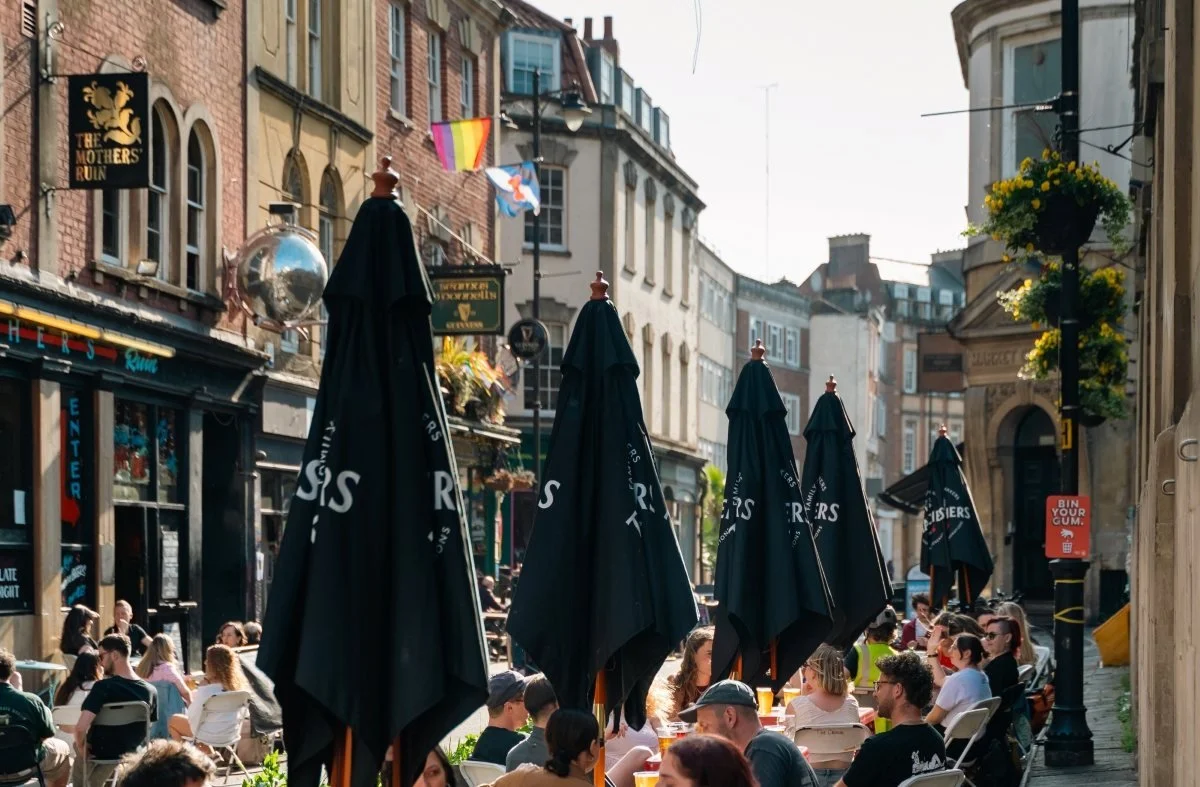
Independent hospitality tends to exist in the public imagination as something quaint and slightly romantic. People picture a cosy pub with warm lighting and a dog asleep by the fire. They picture the friendly owner, the lively atmosphere, the sense that they’ve discovered somewhere with character.
What they rarely picture is the machinery behind that experience. The long hours. The constant balancing act between rising costs and prices customers will tolerate. The weekly exercise of trying to make a business work on margins that would make most industries laugh out loud.
Running an independent venue isn’t a lifestyle business. It’s closer to a prolonged bare-knuckle boxing match with the economy. Rent goes up. Energy costs spike. Suppliers quietly nudge their prices north again. Equipment breaks at precisely the worst possible moment. Someone calls in sick on a Saturday night when the place is full.
Somewhere in the middle of all that, you’re supposed to maintain the illusion that everything is effortless and welcoming.
And yet people keep opening these places.
Not because it’s easy, and certainly not because it’s lucrative. They do it because hospitality, at its best, sits right in the middle of a community. It’s where people celebrate birthdays, meet friends after work, play their first gigs, go on first dates, watch football, argue about politics, and occasionally end up staying far later than they planned.
Chains vs Character
Chains operate differently. That isn’t necessarily a criticism; it’s simply how they’re designed. Chains are built for efficiency and consistency. Walk into one in Manchester or Milton Keynes and you’ll know exactly what you’re getting before you sit down. The systems are centralised, the purchasing power enormous, the experience standardised. It’s impressive in its own way.
But it isn’t the same thing as a place shaped by the personality of the people running it.
Independent venues are messy, idiosyncratic creatures. The music might be different. The menu might change more often than it should. The décor might have evolved over the years rather than appearing fully formed from a corporate design pack. Walk into ten independent pubs on the same street and each will feel like a completely different universe, reflecting the tastes and obsessions of whoever happens to be behind the bar.
That unpredictability is exactly what gives independent hospitality its cultural value. It’s the reason people form attachments to certain places. It’s the reason locals refer to “their” pub, or “their” café, as though it belongs to them in some small emotional way.
When High Streets Flatten
And yet independent venues disappear with surprising regularity. Rarely with drama. Usually quietly. A pub closes. A café disappears behind papered-over windows. A restaurant that did something slightly unusual vanishes from the high street without much fuss.
The street still looks busy enough afterwards. Another brand arrives. The lights go back on. Business continues.
But something subtle has changed.
The places that remain tend to be more uniform, more predictable, more easily replicated from one town to the next. The rough edges get sanded away. The strange little quirks that gave a neighbourhood its character fade out over time, replaced by concepts that have already been tested and refined somewhere else.
Cities become technically functional but culturally flatter.
Independent hospitality is what prevents that flattening. It injects personality and risk into the landscape. It allows people with odd ideas or particular tastes to create places that wouldn’t survive the scrutiny of a corporate boardroom. Some of those ideas fail. Some succeed brilliantly. Either way, they keep a place interesting.
The Bottom Line
Supporting independent venues isn’t about nostalgia or sentimentality. It’s about understanding how local economies actually function. Money spent locally tends to stay local, circulating through the same web of businesses and workers that make up a community in the first place.
If those businesses disappear, the effect ripples outward. Suppliers lose customers. Local employment shrinks. Streets become less distinctive, less varied, less alive.
Which is why the simplest advice still holds true.
Support your neighbour.
Not out of charity, and not out of obligation, but because the alternative is a high street where every venue feels the same, every menu looks identical, and every pint is poured under the same corporate lighting scheme.
That might be efficient.
But it’s a pretty bleak place to have a drink.